Common Wheel Throwing Mistakes: Collapsing, S-Cracks, and Off-Center Rims
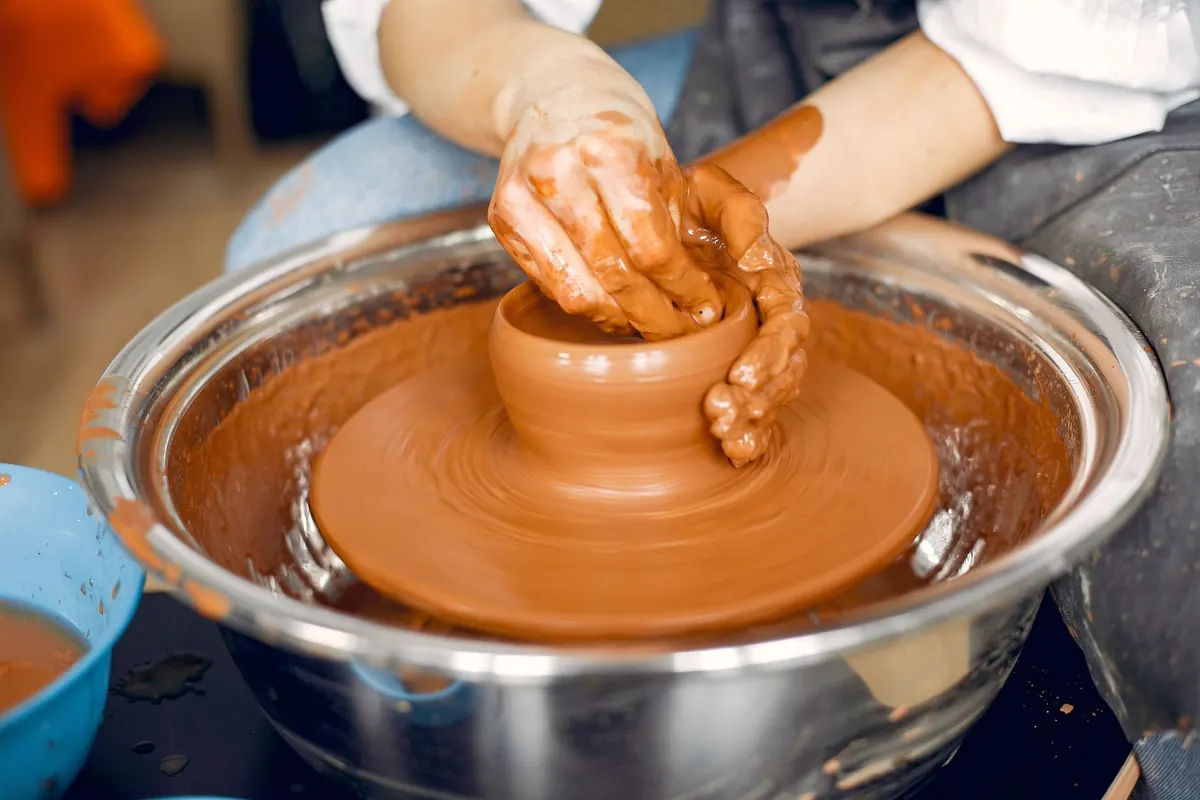
A thrown pot rarely fails for mysterious reasons. The wall that folds over mid-pull, the hairline crack that appears across the base a day later, the rim that rises and dips as the wheel spins — each one traces back to something specific you did or skipped. The encouraging part is that these problems announce themselves early. You just have to know what to watch for, and what to change when you see it.
Most throwing faults begin before your hands touch the spinning clay. If a block was wedged unevenly, one side is stiffer than the other, and that difference drags the pot off axis the moment you apply pressure. Wedge until the clay feels the same all the way through, then shape it into a cone or dome rather than a lopsided lump.
Moisture matters just as much. Clay that is too soft slumps under its own weight; clay that is too stiff fights back and tears. Aim for a consistency where a thumb pressed into the block leaves a clean dent, not a wet smear. Keep one small bowl of water at the wheel rather than a bucket — you want damp hands and a damp rim, not a pot sitting in a puddle of slip.
Finally, match your wheel speed to the task. Fast for centering, slower for opening, slower still for pulling and shaping. Speed hides wobble. It doesn't remove it.
A wall collapses when it is asked to do more than its thickness allows. Three culprits cover nearly every case: walls pulled too thin too early, too much water softening the clay from the outside in, and hands moving faster than the clay can follow.
The fix is patient and a little boring. Pull the wall up in short, overlapping passes rather than one heroic stretch. Move the clay outward at the base before you move it upward, so the wall rises from a supported foundation instead of being dragged up from a thin spot. Keep your outside hand as active as your inside hand; the wall needs counter-pressure, not just a push from within.
When any of these appear, stop pulling. Slow the wheel, dry your hands, and support the outside of the wall with your fingertips while you true the inside with light, even pressure. If the wall is already too thin, let the pot go soft enough to reclaim rather than fighting a losing battle.
An S-crack is that wandering fracture across the base of a pot, usually showing up as the piece dries. It comes from clay that was stretched rather than compressed when you opened the floor, and from a base that dries faster or slower than the walls above it.
Opening is where you earn a sound bottom. Instead of jamming a thumb down and hollowing out a cavity, press from the center outward in overlapping circles, working the clay sideways into the wall. That sideways movement compresses the floor. A wooden rib dragged across the base in firm, overlapping strokes does the same job and leaves a smoother surface.
Thickness consistency is your best insurance. A base an inch thick under walls a quarter-inch thick will shrink at a different rate, and something has to give. Keep the floor only slightly thicker than the wall, trim a clean foot ring once the pot is leather-hard, and turn the piece upside down on a board so air reaches the base. Cover pots loosely with plastic for the first day. Drafty rooms and radiators crack more pots than bad centering does.
Spin a finished pot and watch the rim. If it rises and dips, the problem is almost always uneven pressure: a dominant right hand, a thumb pressing harder than the fingers outside, or a pull that started before the clay was truly centered.
True the rim at the end of every pot, before you take your hands away. On a slow wheel, pinch the rim gently between a sponge outside and your fingertip inside, letting the wheel carry the pot past your hands rather than chasing it. Two or three passes will level it. If the wobble is severe, the pot was never centered in the first place — a second centering pass after the first is not a waste of time, it is the whole job.
Leave the rim slightly rounded rather than knife-thin. A paper-thin rim dries first and fast, and it chips easily on the shelf.
When a pot collapses, don't scrape it off the wheel immediately. Cut it in half with a wire first. You will see exactly where the wall thinned, where the floor was stretched, and how the base compares to the sides — information no amount of reading provides. Keep a small shelf of these cross-sections for a few weeks and the patterns become obvious. Throwing rewards attention more than strength, and every mistake you can name is one you can correct on the next ball of clay.
Photo: Gustavo Fring / Pexels